
Most travelers who book a trip to Cancun or the Riviera Maya think about the beach first, the hotel second, and everything else somewhere after that. The beach and the hotel deserve their attention. But somewhere in that planning process, it’s worth pausing on a question that most people don’t ask until they’re already there: what’s actually within reach from where you’re staying?
Chichen Itza is about two and a half hours from Cancun by road. It’s one of the seven wonders of the modern world, a UNESCO World Heritage Site, and one of the best-preserved Mayan archaeological complexes anywhere in the Americas. It’s also the kind of place where the difference between a great experience and a frustrating one comes entirely down to how you plan it. Get it right, and a day trip to Chichen Itza becomes the thing you talk about for years. Get it wrong, and you spend three hours shuffling through crowds at midday in 35-degree heat.
Here are eight reasons a private tour is the right way to approach it, and why it belongs in your Mexico travel plan.
1. Chichen Itza at Sunrise Is a Completely Different Place
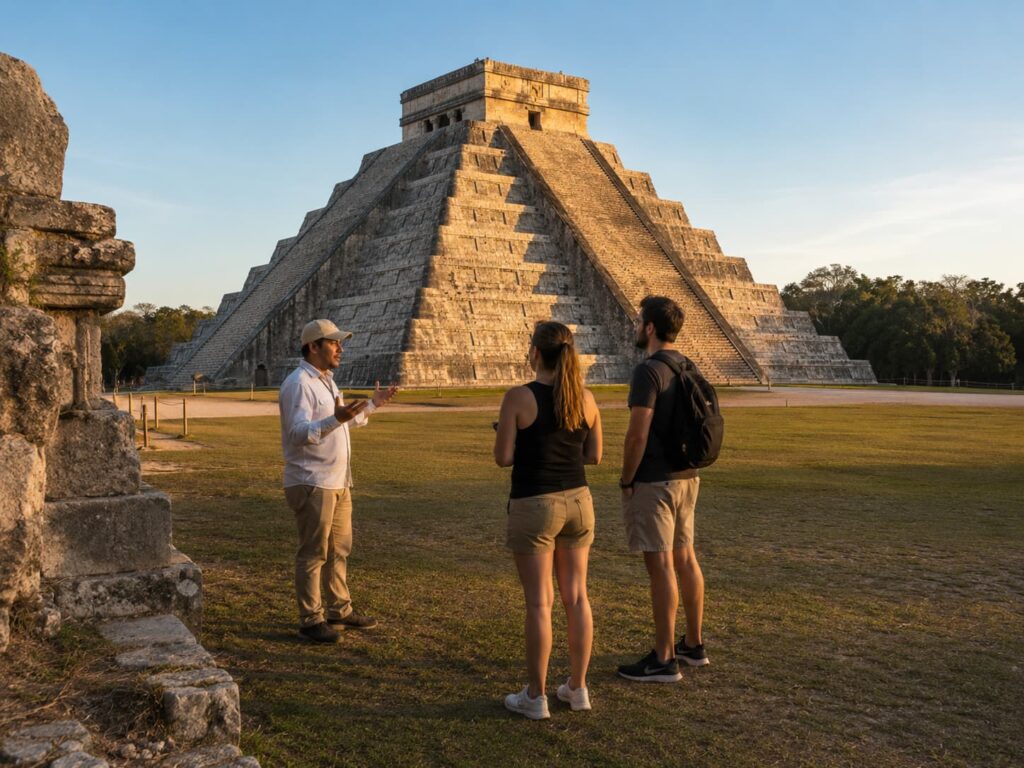
The site opens at 8am, and the large group buses from Cancun and Playa del Carmen typically arrive around 11am. That three-hour window is the entire difference between having the ruins to yourself and sharing them with several thousand people. In the early morning, the light is low and directional, the temperature is bearable, and El Castillo, the famous stepped pyramid at the centre of the site, reflects the morning sun in a way that the midday version simply doesn’t.
Getting there for opening requires leaving your hotel by 5 or 5:30am, which is early. Most group tours don’t run on that schedule. A private tour does, and that early start is arguably the single most important variable in the quality of the whole experience. The ruins themselves don’t change. The crowd does.
2. The Archaeological Site Is Larger Than Most Visitors Expect
Most photos of Chichen Itza show El Castillo, the Temple of Kukulcan, and not much else. The actual site covers several square kilometres and includes structures that most day-trippers never reach: the Great Ball Court, the longest in Mesoamerica at 168 metres; the Temple of the Warriors with its forest of carved columns; the Sacred Cenote, a natural sinkhole where ritual offerings were deposited for centuries; the Group of a Thousand Columns; and the astronomical observatory known as El Caracol, among others.
Walking the full site properly, with time to look and understand what you’re looking at rather than just moving between photo spots, takes two to three hours at a minimum. Group tours rarely allow this. They hit the main structures and move on. A private itinerary can be built around what you actually want to see, at a pace that makes the archaeology legible rather than just scenic.
3. The History Here Changes How You Think About Ancient Civilisations
Chichen Itza was a major Mayan city from around the 6th century CE through to roughly the 13th century, when it went into decline for reasons that archaeologists are still working out. At its peak it was one of the largest cities in the pre-Columbian Americas, with a population estimated in the tens of thousands and an urban layout that reflects sophisticated understanding of astronomy, hydraulics, and mathematics.
El Castillo is the most visible expression of this. The pyramid has 91 steps on each of its four sides, plus the top platform: 365 in total, corresponding to the days of the solar year. At the spring and autumn equinoxes, the shadow cast by the staircase creates the illusion of a serpent descending the north face of the pyramid. This was not accidental. The entire structure is a working calendar built in stone, aligned with astronomical events to a precision that required centuries of observation to achieve. Knowing this before you stand in front of it changes what you see.
4. A Private Guide Unlocks the Meaning Behind What You’re Looking At
The structures at Chichen Itza are dense with iconography, astronomical alignment, and political symbolism that is invisible without context. The carvings on the Temple of the Warriors depict specific historical events and ritual practices. The acoustics of the Great Ball Court, which can carry a whispered voice from one end to the other across 168 metres, were deliberate. The orientation of El Caracol toward the planet Venus was intentional and functional.
None of this is visible to a visitor walking around with an audio guide or a general group tour. A specialist guide who knows the site reads the archaeology aloud as you move through it. The carvings stop being decoration and start being text. The layout of the city stops being random and starts being a plan. Operators like Chichen Itza Private Tours provide exactly this kind of specialist-led experience, with guides whose depth of knowledge in Mayan history and archaeology makes every structure in the complex a source of actual information rather than a backdrop for photographs.
5. The Cenotes Near the Site Are Worth Half a Day on Their Own
The Yucatan Peninsula sits on a limestone shelf honeycombed with underground rivers and sinkholes, called cenotes, that were sacred to the Maya and remain some of the most striking swimming environments anywhere in the world. Several cenotes are located within a short drive of Chichen Itza, including Ik Kil, one of the most photogenic in the region, with its open-sky pit dropping 26 metres to a clear freshwater pool hung with trailing vines and roots.
A well-constructed private tour builds in a cenote stop after the archaeological site, giving you time to cool down in the water after a morning in the sun before heading back. This is a detail that most standard day trip packages either skip entirely or rush through, but it’s a significant part of what makes the Yucatan distinctive as a travel destination. The limestone landscape, the underground water systems, and the archaeology are all connected parts of the same environment, and experiencing them together in a single day gives you a much more complete picture of the region.
6. Choosing the Right Hotel Base Makes the Logistics Work
The quality of a Chichen Itza day trip depends heavily on where you’re staying. Cancun is the most common base, and the drive is manageable, but the 5am departure time is harder to absorb in a large resort environment not set up for early checkout. Valladolid, a colonial town about 45 minutes from the site, is an alternative worth considering: smaller, quieter, and positioned so that an early site arrival requires only a short early morning drive.
Merida, the capital of Yucatan state, is another strong option. It’s about 1.5 hours from Chichen Itza in the opposite direction from Cancun, offers some of the best colonial-era hotels in Mexico, and functions as a proper city with a food and cultural scene that Cancun’s hotel zone doesn’t try to replicate. For travelers who want the Yucatan’s archaeology as the centrepiece of the trip rather than an add-on to a beach holiday, Merida works better as a base. As we’ve covered in our guide to planning your next travel adventure, matching your accommodation choice to your actual itinerary is one of the most consistently underrated decisions in travel planning.
7. The Town of Valladolid Is Worth an Extended Stop
Most Chichen Itza day tours from Cancun drive past Valladolid or stop briefly for lunch. The town deserves more time than that. Its central square, the Parque Francisco Canton, is surrounded by 16th and 17th-century colonial architecture in good condition, and the church of San Servacio on the park’s eastern edge is one of the better examples of early Mexican colonial ecclesiastical building in the region.
The town also has its own cenote: Cenote Zaci, right in the urban centre, accessible within a few minutes’ walk from the main square. Eating lunch in Valladolid proper rather than at one of the tourist restaurants near the archaeological site gives you access to a much better version of Yucatecan food: cochinita pibil, sopa de lima, papadzules, and the regional version of black bean soup that tastes nothing like the international approximation. A private tour that builds in time here rather than rushing back to the highway is a meaningfully better day.
8. The Equinox Visit Is Worth Planning a Trip Around
Twice a year, at the spring equinox in late March and the autumn equinox in late September, the afternoon shadow cast by El Castillo’s northwest corner falls across the staircase balustrade in a way that creates the appearance of a feathered serpent descending from the top of the pyramid to the ground. The effect lasts for roughly 45 minutes and has been drawing visitors since archaeologists first documented it in detail in the 20th century.
The equinox crowds at Chichen Itza are significantly larger than normal, which means the standard advice about early arrival applies even more strongly. A private tour arranged for equinox timing, with a guide who knows where to position you for the best view of the shadow effect and how to navigate the site before and after, produces an experience that goes well beyond a standard ruin visit. It’s the kind of day that justifies building a whole trip around a specific date. Our overview of how to choose the right hotel covers the logistics of accommodation selection, and for an equinox visit, getting that choice right, staying close to the site rather than driving two and a half hours each way, makes a substantial difference to what the day actually delivers.
A Final Thought
Chichen Itza is one of those destinations that almost every traveler to Mexico’s Caribbean coast considers and most eventually visit. The ones who visit it as a rushed group day trip from Cancun come back with photos and a vague sense of having been somewhere significant. The ones who plan it properly, early start, private guide, cenote stop, proper lunch in Valladolid, come back with a day that reframes the whole trip.
The difference in cost between those two experiences is smaller than most people expect. The difference in what you actually get is not small at all.
If Chichen Itza is on your Mexico itinerary, it’s worth doing it once and doing it right.